How to Research Thrift Store Items for Resale: A $2.99 Cabbage Platter Case Study
You don’t have to recognize everything you find at a thrift store to be a good reseller.
Knowing how to figure out what you’re looking at can be much more useful.
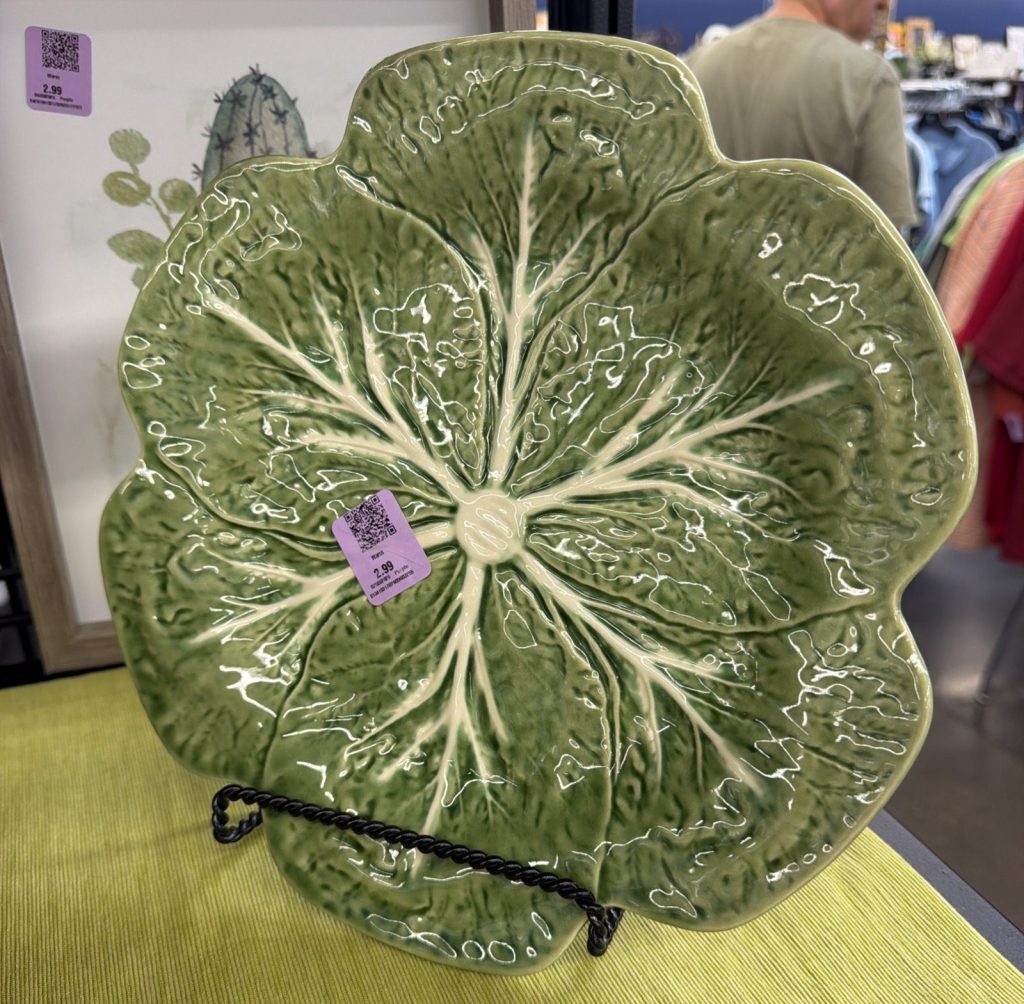
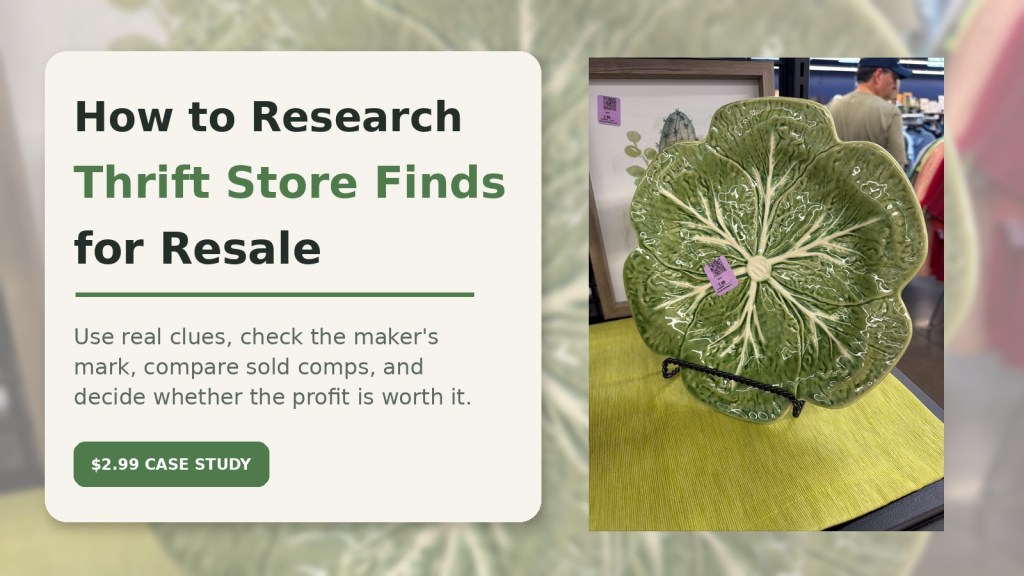
I recently spotted a large green cabbage leaf plate at the thrift store for just $2.99.
It definitely caught my attention.
The glaze was bright green, the leaves were deeply textured and the entire piece looked much more interesting than an ordinary serving plate.
But interesting doesn’t automatically mean valuable.
Before putting something in my cart, I want to answer a few questions:
Who made it?
What exactly is it?
Are people buying it?
What are they actually paying?
And finally:
Is there enough profit here to make it worth selling?
This cabbage plate turned out to be a great example of how I work through that process.
Step 1: Start With What You Can Actually See

Before using Google Lens or searching eBay, I look at the item itself.
From the front, I could tell that this was:
- Green glazed ceramic
- Designed to resemble cabbage leaves
- Round
- Large enough to be a serving plate, charger or platter
- Heavily textured
- Priced at $2.99
What I didn’t know yet was the maker or age.
That’s an important distinction.
One of the easiest ways to make a bad reselling decision is to see something that resembles an expensive piece and immediately decide that’s what you’ve found.
I try to start with a much simpler rule:
Describe first. Identify second.
Step 2: Look at the Bottom Before Doing Anything Else
One of the first things I do with pottery, dishes, figurines, glassware and decorative objects is turn them over.
The bottom can give you more information than the front.
Look for:
- Maker’s marks
- Logos
- Country of origin
- Pattern names
- Model or mold numbers
- Stickers
- Signatures
- Copyright information
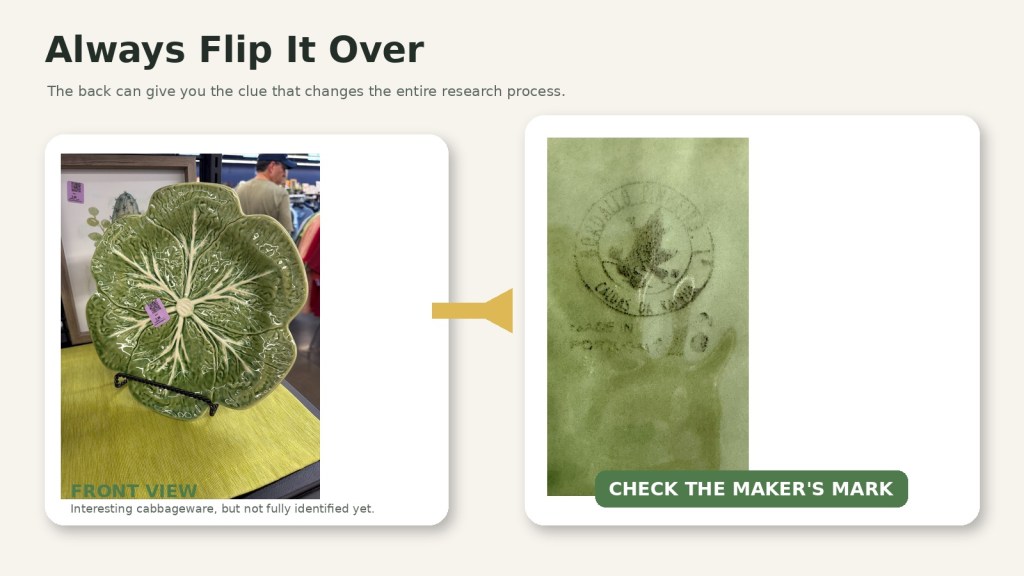
When I turned this cabbage plate over, there was a very faded circular stamp.
But there was enough left to identify it.
I could see the Bordallo Pinheiro name around the circular mark and the company’s distinctive frog motif in the center.
The registered Bordallo Pinheiro trademark uses that same circular design with the company name around a central frog or toad.
Now I wasn’t researching an unidentified cabbage plate anymore.
I had a maker.
Step 3: A Maker's Mark Doesn't Answer Everything
This is where I think it’s important not to get carried away.
Finding the Bordallo Pinheiro stamp authenticates the maker.
It does not automatically tell me that the piece is antique or vintage.
Bordallo Pinheiro still produces its famous Cabbage collection today. The current collection includes plates, bowls, chargers and platters in the same recognizable leafy style.
For example, the company currently lists a green Cabbage dinner plate for $45 and Cabbage charger plates around $80.
So I am comfortable saying:
This is Bordallo Pinheiro.
But I would want more information before assigning a specific age to it.
That’s another reseller rule worth remembering:
Don’t turn something you know into something you hope.
A maker’s mark confirms the maker.
It doesn’t automatically confirm the date.
Step 4: Use the Identification to Improve Your Search
Before finding the mark, I might have searched:
green cabbage plate
or:
ceramic cabbage platter
Those searches could bring back dozens of similar looking dishes from different manufacturers.
Now I can be much more precise:
Bordallo Pinheiro cabbage plate
Bordallo Pinheiro green cabbage charger
Bordallo Pinheiro cabbage serving platter
And after measuring the piece, I would include the exact size.
This is where measurements become very important.
A small salad plate and a large charger may look almost identical in an online photograph but have very different values.
Step 5: Use Google Lens to Find Vocabulary, Not an Answer
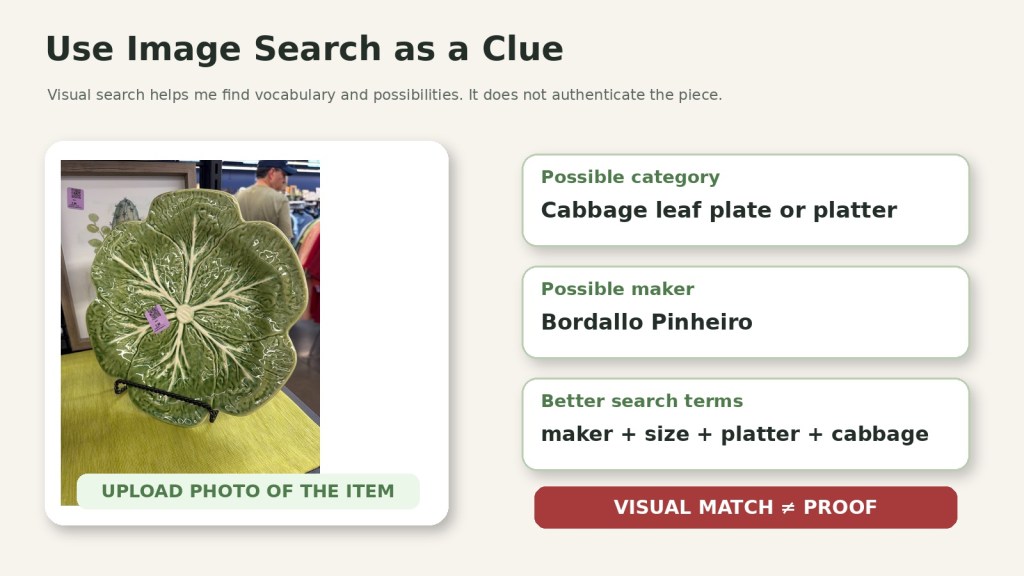
Image search is one of my favorite reseller tools because it can help when I don’t even know what something is called.
A photo of this platter may produce results using terms such as:
cabbage leaf platter
cabbageware
majolica-style pottery
lettuce leaf platter
Portuguese cabbage pottery
Those words are extremely useful.
But there is an important distinction:
Google Lens is giving me possibilities.
It is not authenticating my piece.
The cabbage design is strongly associated with Portuguese maker Bordallo Pinheiro, whose current Cabbage collection includes plates, platters, bowls and other tableware.
That makes Bordallo an important name to know.
It does not mean every green cabbage plate is Bordallo.
Step 6: This Is Where Lookalikes Become Important
While researching this platter, I found a particularly interesting result.
An eBay seller currently has a Pier 1 Imports Hand Painted Dolomite Cabbage Leaf Platter Plate 14” listed for $49.99.
The seller identifies that piece as Pier 1 Imports, made in China, and hand painted.
Visually, it appears extremely close to the thrift-store platter.
If the mark on the back of my plate were faded or I couldn’t see it at all, this would be valuable information.
But I still want to compare the back of my piece before stating that it is definitely the same product.
That little distinction is important.
Research should narrow possibilities.
It should not turn possibilities into facts.
Margaret's Reseller Tip
Google Lens finds things that LOOK similar. It does not authenticate your item.
Before using a brand name in your listing, look for a matching mark, label, construction detail or other evidence that supports the identification.
That is a concept I would start repeating across your videos and website. It could become one of the things viewers associate specifically with your way of teaching reselling.
And for this particular item, please photograph the back if you can. The backstamp could turn this from a general research example into an even better video because we may be able to conclusively determine whether you’ve got that Pier 1 platter or something else.
Step 7: Never Confuse an Asking Price With Value
Finding an active listing for $49.99 does not mean I now own a $49.99 platter.
That is simply what one seller is asking.
If I want to determine what buyers are actually paying, I need sold listings.
On eBay I would search several versions:
Pier 1 cabbage platter
Pier 1 cabbage leaf platter
Pier 1 cabbage platter 14 inch
Then I would filter for completed or sold items.
Buyer feedback on eBay confirms that this same titled Pier 1 14-inch cabbage platter has been purchased previously, so there is at least evidence of actual buyer demand for the piece.
I would still use the most current sold results available when I am making my buying or pricing decision.
Step 8: Don't Compare Your Item to a More Valuable Version

This is where research can go wrong very quickly.
Suppose I search:
green cabbage platter
and find sold Bordallo Pinheiro pieces.
Recent marked Bordallo examples have sold on eBay at prices including $42.99 for a 10.5-inch dinner plate, $65 for a 15-inch platter and $74.99 for a 13.5-inch platter.
Those sales tell me something important:
People buy cabbageware.
What they do not tell me is that an unmarked or Pier 1 platter should sell for the same amount.
If my piece was a Pier 1, I need Pier 1 comparisons.
If my piece is Bordallo, I need Bordallo comparisons.
If it is unmarked, I need the best unmarked comparisons I can find.
This is why good reseller research is about comparing apples to apples, not simply finding the highest price attached to something that looks similar.
Now comes one of the most important parts of my research.
I don’t want to know only what sellers are asking for Bordallo Pinheiro cabbageware.
I want to know what buyers are actually paying.
Recent eBay sales show why exact comparisons matter.
A used 12 inch green Bordallo Pinheiro cabbage charger sold for $28.95 in August 2026. Another 12 inch example sold for $49.99 in May.
A set of three 12 inch Bordallo cabbage chargers sold for $180.
Larger serving pieces can sell higher. A 13.5 inch green cabbage platter sold for $74.99, while a 15 inch oval platter sold for $65.
Those aren’t necessarily exact matches for my piece.
And that’s the point.
Good comps should be as close as possible.
I want to compare:
- Same maker
- Same collection
- Similar size
- Similar shape
- Similar condition
- Similar number of pieces
Finding the highest priced Bordallo item on eBay and deciding mine must be worth the same amount isn’t research.
It’s wishful thinking.
Step 9: Examine the Condition Carefully
At $2.99 it would be easy to get excited and put this straight into the cart.
But large pottery needs a careful inspection.
I would run my fingers around every edge and check for:
- Chips
- Cracks
- Hairlines
- Crazing
- Repairs
- Stains
- Glaze damage
Pay particular attention to raised leaves and scalloped edges.
Those are exactly the areas that can get chipped.
Step 10: Think About Shipping Before You Buy
A $2.99 purchase price gives me plenty of room for profit.
But buying price is only one part of the equation.
This platter is large and breakable.
That means:
- Larger box
- More packing materials
- Higher shipping weight
- More time packing
- Greater risk of damage
This is why I don’t ask only:
Can I sell this for more than I paid?
I ask:
Will I make enough to justify everything involved in selling it?
That is a much better question.
Final Verdict: Would I Buy This $2.99 Cabbage Platter?
Assuming I checked it carefully and found no chips, cracks or repairs, yes, at $2.99 I would likely buy it.
But the reason matters.
If I was unsure of the maker, I would not buy it because I assumed it was valuable Bordallo Pinheiro pottery.
I would buy it because:
- My cost is very low
- The design has buyer appeal
- Comparable cabbageware is actively bought and sold
- I found evidence of a very similar Pier 1 product
- Further research can help me price it appropriately
And when the backstamp revealed that I actually had a marked Bordallo Pinheiro piece?
I have several pieces of information supporting the decision:
- The backstamp identifies Bordallo Pinheiro.
- Cabbage is an established Bordallo Pinheiro collection still sold by the company today.
- Used Bordallo cabbage pieces have recent completed sales.
- Comparable larger pieces can sell well above my $2.99 purchase price.
- My initial investment is extremely low.
That is a very different buying decision from:
“This looks expensive, so I’m buying it.”
The Bigger Lesson: Don't Upgrade Your Item During Research
This platter perfectly illustrates one of the habits I think every reseller should develop.
Don’t upgrade your item during research.
That means:
“Looks like Bordallo” does not become “Bordallo.”
“Looks Mid-Century” does not become “Made in the 1960s.”
“Looks like sterling” does not become “sterling silver.”
“Similar to a designer piece” does not become “designer.”
Instead, keep separating what you know from what you suspect.
That keeps your purchases smarter and your listings more accurate.
My Quick Thrift Store Research Process
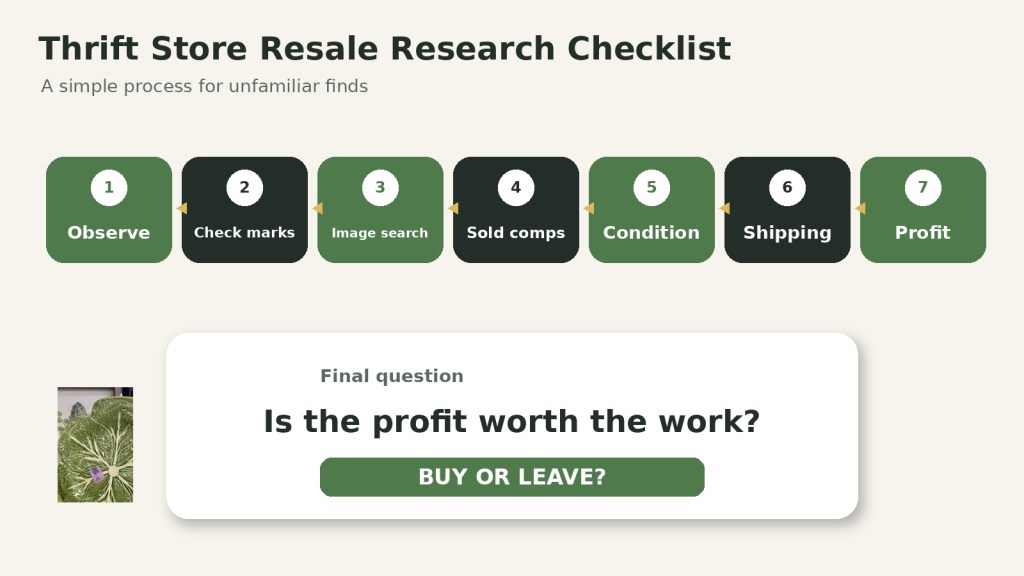
When I find an unfamiliar item, I generally work through this checklist:
- Describe what I actually see.
- Look for maker’s marks and labels.
- Use Google Lens to discover similar items and better terminology.
- Search several combinations of descriptive keywords.
- Look for an exact or very close match.
- Check sold listings rather than relying on asking prices.
- Make sure the comps are truly comparable.
- Inspect condition carefully.
- Think about storage and shipping.
- Decide whether the realistic profit is worth my time.
You do not need to know every collectible, manufacturer or piece of pottery before walking into a thrift store.
You just need a reliable system for figuring things out.
Final Thoughts
This $2.99 cabbage plate is exactly the kind of thrift-store find that keeps reselling interesting for me.
At first it was simply:
“That’s unusual.”
Then I flipped it over.
The faded maker’s mark gave me a name.
The name gave me better searches.
The searches gave me actual sold prices.
And all of those pieces together helped me make a much smarter buying decision.
That’s the skill I want new resellers to develop.
You don’t need to walk into a thrift store already knowing everything.
You just need to know what to do when you don’t know.
Frequently Asked Questions
How do I identify a thrift-store item if it has no maker’s mark?
Start with physical characteristics rather than trying to guess the maker. Photograph the item, use Google Lens or another visual search, and gradually add descriptive terms such as material, shape, color, function and construction.
Can I use Google Lens to determine what something is worth?
I wouldn’t use image search alone to determine value. Lens can be very useful for identification and terminology, but I still want marketplace data showing what comparable items have actually sold for.
Should I use active eBay listings to price my item?
Active listings are useful for understanding competition, but asking prices do not prove market value. Sold data gives you better evidence of what buyers have actually been willing to pay.
What if I can’t find my exact item?
That happens constantly with vintage and secondhand merchandise. Work outward from the closest characteristics you can verify: maker if known, material, construction, size, style, function and age. You may need to use comparable rather than identical sales.
How long should I spend researching an item?
There is no single answer, but keep the potential profit in mind. If an hour of research is unlikely to materially change what you can earn from the item, it may be time to stop.