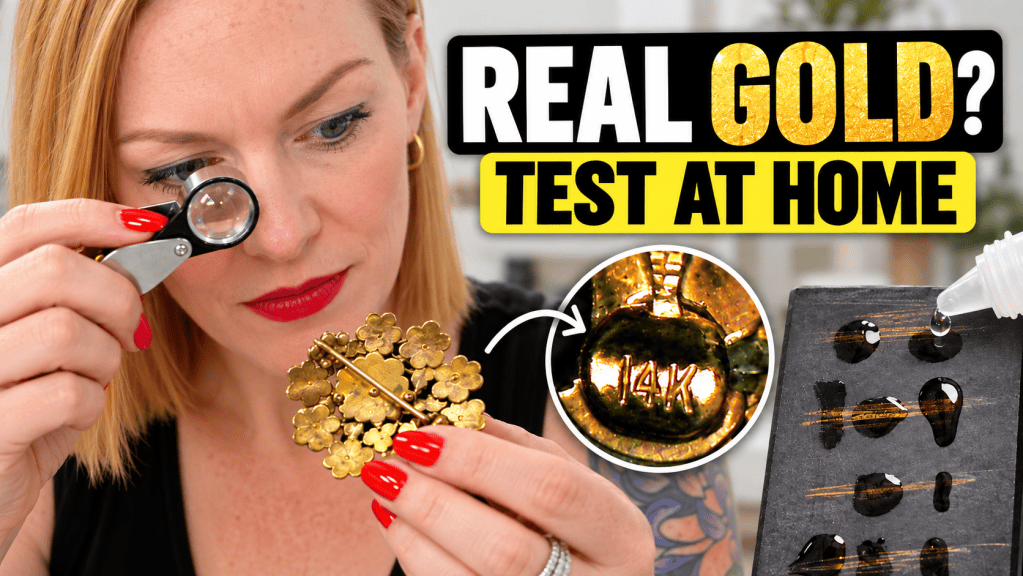
How to Test Gold at Home: Real vs Fake Gold Jewelry With an Acid Test
You find a piece of jewelry at a thrift store, estate sale, garage sale, or in the bottom of a jewelry jar.
It looks like gold.
Then you get out your loupe and find a tiny 14K stamped somewhere on the back.
So…is it really gold?
Maybe.
A gold mark is an important clue, but I don’t automatically assume a piece is genuine just because I find a stamp. When I’m researching jewelry for resale, I look at the entire piece first and then, when it makes sense, I use a gold testing stone and acid testing solutions to get more information.
In this guide, I’ll show you how I test gold jewelry at home, what common gold marks mean, how I interpret an acid test, and some of the reasons a test can give you a misleading result.
Quick answer: I make one long streak from the jewelry on a clean testing stone. Then I place small, separate drops of my different gold testing acids along that same streak, keeping the drops far enough apart that they never touch or mix. I watch how the metal under each solution reacts. The highest-karat testing solution the streak withstands helps me narrow down the approximate gold content.
Touchstone testing is a long-established method for estimating the purity of karat gold. GIA describes it as a relatively nondestructive method that uses the way gold alloys react to progressively stronger acids to help determine their fineness.
First: Inspect the Jewelry Before You Test It
The acid bottles are not the first thing I reach for.
My first tool is usually my loupe.
I’m checking the clasp, inside of a ring, back of a brooch, pendant bale, earring post, bracelet ends, and anywhere else a manufacturer might have put a mark.
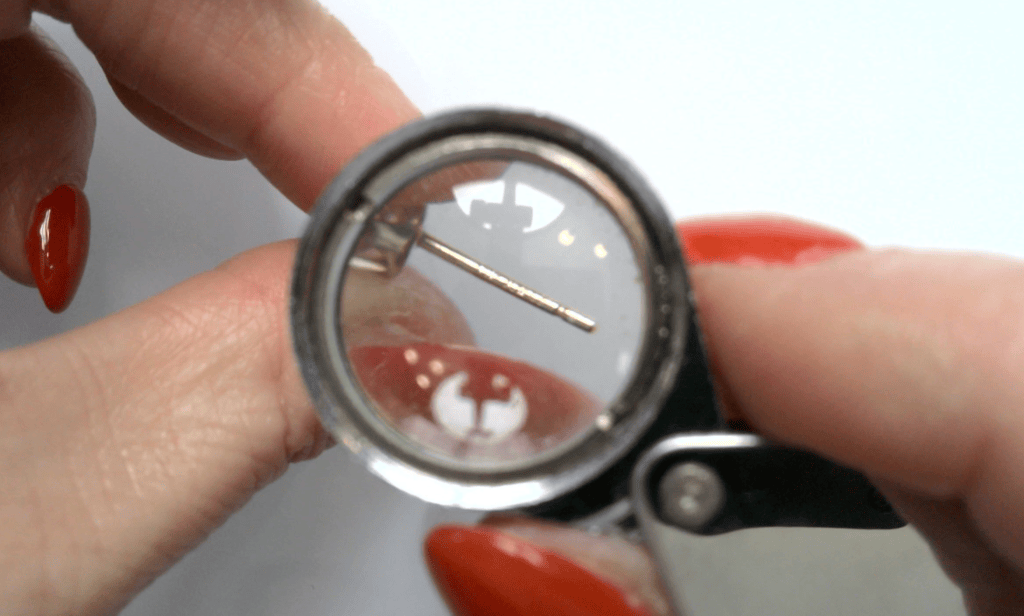
You might find familiar marks such as 10K, 14K or 18K, but you may also find a three-digit fineness number.
Common gold purity marks
| Mark | Gold content | Equivalent |
|---|---|---|
| 10K / 417 | 41.7% | 10 karat |
| 12K / 500 | 50% | 12 karat |
| 14K / 585 | 58.5% | 14 karat |
| 18K / 750 | 75% | 18 karat |
| 22K / 916 | 91.6% | 22 karat |
| 24K / 999 | About 99.9% | Very high-purity |
For example, 14K means 14 of the 24 parts in the alloy are gold, while the other 10 parts consist of other metals. The FTC explains gold karat markings using this same 24-part system.

A 14K Stamp Is a Clue, Not Proof
This is one of the biggest mistakes I see newer jewelry resellers make.
They find 14K and immediately decide:
This is a 14K gold piece.
I don’t jump that far yet.
The stamp makes me much more interested, but I still examine the jewelry.
A clasp may have been replaced.
A piece may have been repaired.
One component could be gold while another isn’t.
Plating can complicate things.
And a mark itself can be misleading.
The FTC recommends looking for the manufacturer’s name or registered trademark near a karat quality mark because that’s the party standing behind the stated metal content.
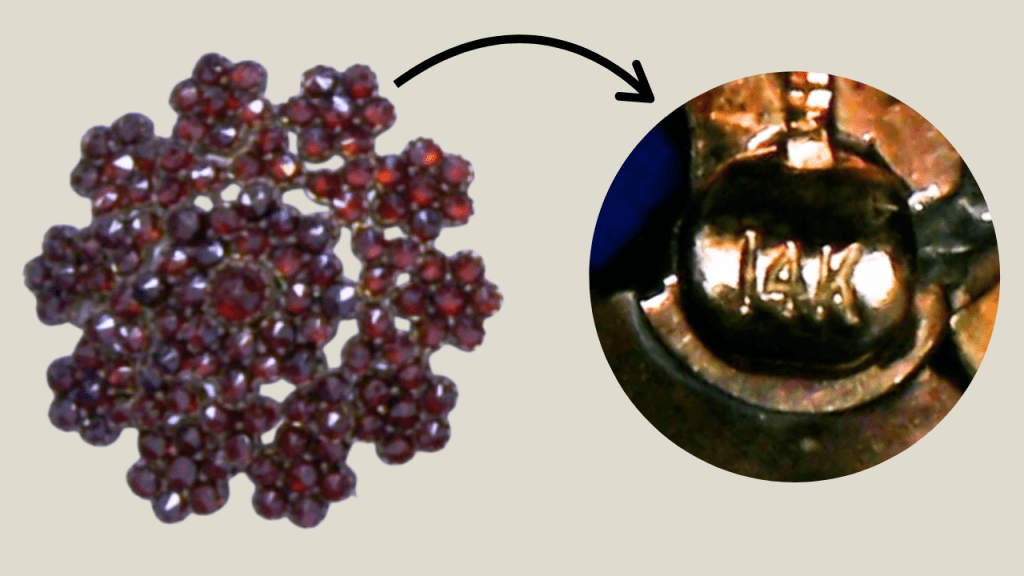
This particular piece is a great real-world example because visually the brooch doesn’t scream “valuable gold jewelry.” That’s exactly why checking the back matters.
Gold Filled, Gold Plated and Vermeil Are Different From Karat Gold Throughout
This is where understanding the entire mark becomes extremely important.
A piece can have real gold on its surface without being made from that gold alloy throughout.
| Mark | Generally means |
|---|---|
| GF | Gold filled |
| 1/20 12K GF | Gold-filled item with the stated gold layer |
| RGP | Rolled gold plate |
| GP | Gold plated |
| HGE | Heavy gold electroplate |
| GEP | Gold electroplate |
| Vermeil | Gold over sterling silver |
The FTC describes gold-filled, gold overlay and rolled-gold-plate jewelry as having a gold layer mechanically applied over another metal. Vermeil uses sterling silver as its base with gold applied over it. Consumer Advice
That does not mean those pieces are worthless. Vintage gold-filled jewelry can absolutely be collectible and resellable.
It simply means you shouldn’t describe it as though the piece were made throughout from that karat gold alloy.
How I Test Gold at Home With Acid
There are several variations of touchstone testing.
I’m showing you the method I personally use with my testing kit.
Follow the instructions for your own acids because products and procedures can differ.
1. Make One Good Streak

I choose an inconspicuous area of the jewelry and rub it firmly across a clean testing stone.
I want one long, clearly visible streak.
I’m not trying to grind half the piece onto the stone. I just need enough metal transferred to get a readable result.
2. Put Separate Acid Drops on the Same Streak
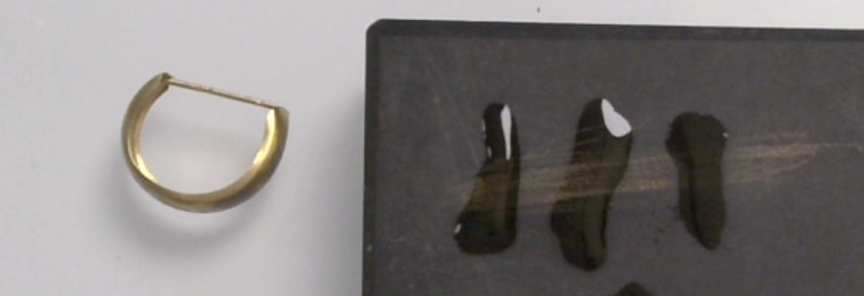
This is the part of my method that I wanted the video to show clearly.
I use one streak.
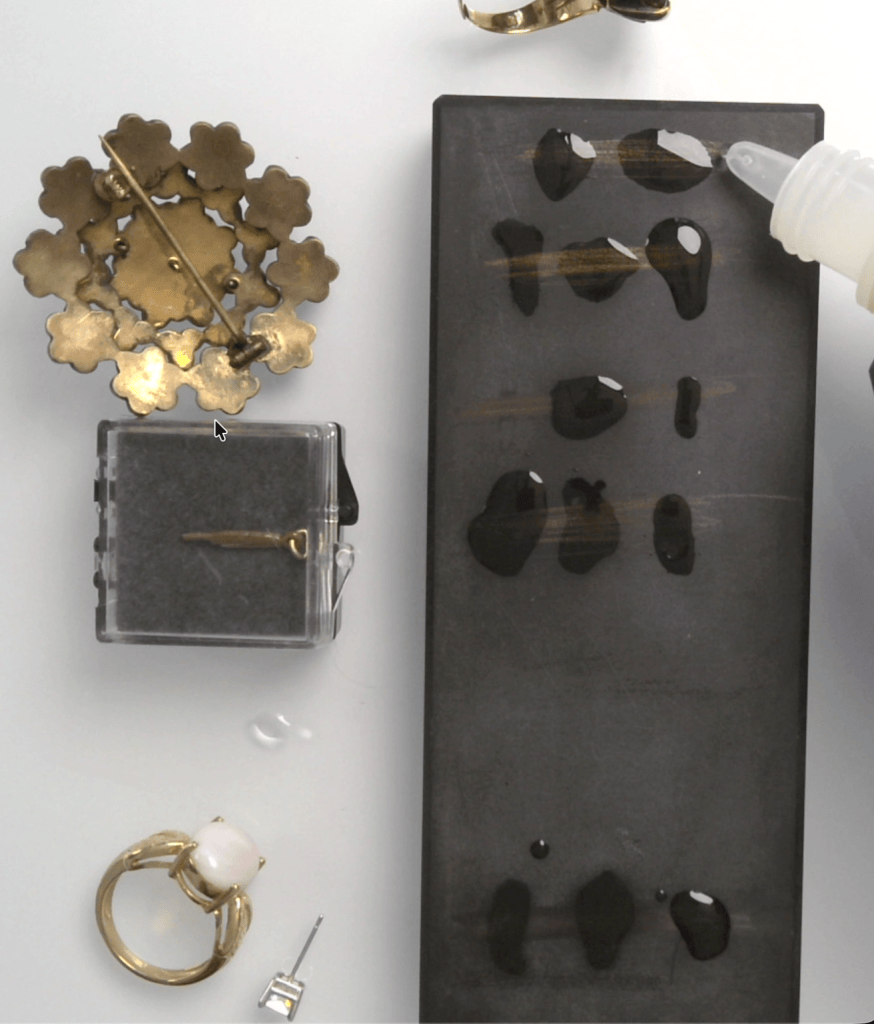
Then I place small drops from the appropriate testing acids at separate points along it.
For example:
10K → 14K → 18K → 22K
The drops are spaced apart.
They do not touch.
They do not mix.
That lets me compare what is happening to different parts of the same streak.
3. Watch What Happens Under Each Acid
Now I watch the streak.
If the metal remains clearly visible under one solution but becomes weaker or disappears under the next stronger testing solution, that helps narrow down the approximate karat.
GIA explains the underlying principle this way: purer gold requires a stronger acid to dissolve it, which allows touchstone testing to progressively narrow the fineness of an unknown gold alloy.
Example: A Piece Testing Around 14K
Imagine this result:
| Acid | Result |
|---|---|
| 10K | Streak remains |
| 14K | Streak remains |
| 18K | Streak fades/disappears |
| 22K | Streak disappears |
That result would be consistent with a piece testing approximately in the 14K range.
I deliberately say approximately.
This is a home screening method. It is not the same thing as a laboratory assay.
Why Gold Plating Can Make Testing Tricky
Here is where things get more interesting.
A touchstone only knows about the metal that you transferred onto the stone.
If the surface of a piece is genuinely gold but the interior is another metal, you can potentially transfer that gold surface to your testing stone.
So a positive-looking surface result doesn’t necessarily prove that the entire piece is made from that alloy.
GIA notes that professionals may expose fresh underlying metal when plating is suspected before testing. gia
For an inexpensive mystery piece, you may decide additional testing makes sense.
For an antique, designer or potentially valuable piece, I would not start filing into it just because I wanted an answer.
That’s a situation where professional testing may be the better decision.
What if the Mark and the Gold Test Don't Match?
This is where I don’t try to force the result I wanted.
Let’s say I clearly see:
14K
But the piece isn’t behaving like I expect under the acid.
Now I start asking questions.
Did I test the same component that carries the mark? Could the clasp have been replaced? Is there evidence of a repair? Could the piece be plated? Was my testing stone clean? Did I accidentally test close to solder? Are the acids still reliable?
Then I test again in another appropriate area.
If I’m still getting contradictory information, my conclusion isn’t:
“Well, it says 14K, so I’m calling it 14K.”
My conclusion is:
I don’t know yet.
And that’s okay.
For resellers, accurate identification matters. The FTC’s Jewelry Guides emphasize truthful representation of precious-metal content and other material characteristics.
Vintage British Gold Marks Look Different
If you sell a lot of vintage jewelry, eventually you’re going to find marks that look nothing like a simple American 14K.
British hallmarks can contain several individual symbols.
Modern UK hallmarking uses three compulsory elements:
Sponsor’s mark + fineness mark + assay-office mark.
Traditional metal symbols such as the gold crown and a date letter can also appear, but they are voluntary additions today. Sheffield Assay Office
The current UK assay offices use identifying symbols including London’s leopard’s head, Birmingham’s anchor, Sheffield’s rose and Edinburgh’s castle.
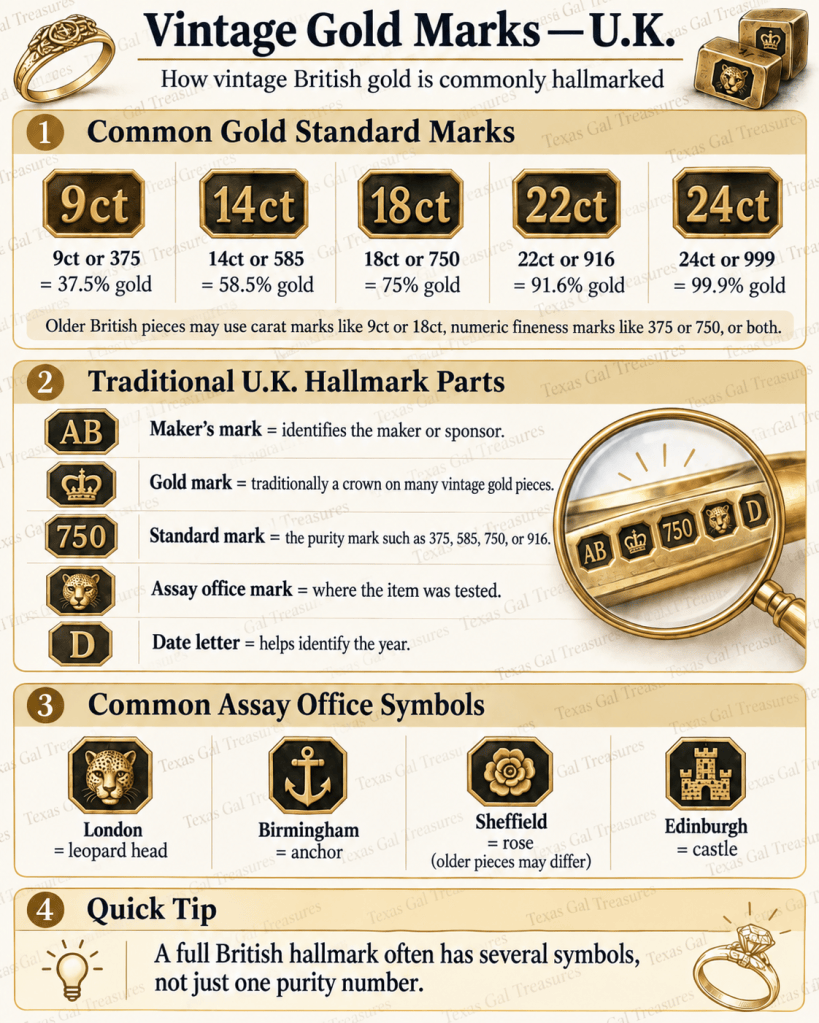
Today: sponsor’s mark, fineness mark and assay-office mark are compulsory. Traditional metal marks and date letters are voluntary.
Can You Tell if Gold Is Real Without Acid?
There are plenty of other clues I use before or alongside acid testing.
A strong magnet response, weight, visible wear, hallmark quality, construction, maker information and color can all tell me something.
But none of those clues alone gives me a magic yes-or-no answer.
For example:
“It doesn’t stick to a magnet” does not mean “it is gold.”
Lots of other metals aren’t strongly magnetic either.
My actual process is closer to:
Inspect → Research → Test → Compare → Verify
That’s also why I would be cautious with viral “test your gold with toothpaste/vinegar/baking soda” tricks.
If knowing the answer affects the value of the jewelry, I’d rather use a method designed for precious-metal testing.
Is Acid Testing Gold Completely Accurate?
No home test should be treated like an infallible laboratory result.
Professional alternatives include methods such as X-ray fluorescence (XRF) and fire assay. GIA describes touchstone testing as a much simpler and relatively nondestructive option, while noting that more precise scientific methods require specialized equipment or procedures. gia
For most of my everyday reseller research, I don’t need to send every thrift-store earring to a laboratory.
I need enough good evidence to make a responsible decision.
For something unusually valuable, historically important or difficult to interpret, professional verification becomes much more worthwhile.
Gold Testing Safety
Gold testing acids are corrosive chemicals.
I use appropriate gloves and eye protection, work in a well-ventilated area, keep food and drinks away from my testing setup, and keep the chemicals away from children and pets.
I also follow the storage, neutralizing and cleanup instructions provided with my particular testing kit.
GIA similarly recommends protective gloves, safety goggles, ventilation, proper neutralization and careful handling when touchstone acids are used. gia
Don’t assume that because the bottle is tiny, the chemical inside it isn’t capable of hurting you.
Frequently Asked Questions About Testing Gold at Home
What does 585 mean on jewelry?
585 indicates approximately 58.5% gold, which corresponds to 14-karat gold.
What does 750 mean on jewelry?
750 indicates approximately 75% gold, corresponding to 18K gold.
What does 417 mean on jewelry?
417 is approximately 41.7% gold, corresponding to 10K.
Does a 14K stamp prove jewelry is real gold?
No. It is important evidence, but I still evaluate the entire piece and test when appropriate.
Does GF mean fake gold?
No. GF normally refers to gold filled. Gold-filled jewelry contains a mechanically applied layer of real karat gold over another metal. It isn’t the same construction as karat gold throughout, but that doesn’t make the gold layer “fake.” The FTC distinguishes gold-filled jewelry from both karat-gold and electroplated products. Consumer Advice
Does GP mean solid gold?
No. GP commonly indicates gold plated.
What is vermeil?
Vermeil is gold applied over a sterling-silver base. Consumer Advice
Can acid testing detect gold plating?
It can sometimes raise suspicion, but a surface test can also be fooled by a genuine gold coating. If plating is a concern and the answer matters financially, additional testing is appropriate.
Do I put the acid directly on the jewelry?
With the method shown in this guide, no. I transfer metal from the piece onto the testing stone and apply the acid to the streak.
The Biggest Lesson: Don't Test to Prove What You Hope Is True
This may be the most important part.
When I see 14K, I want it to be 14K.
Of course I do.
That’s a much more fun thrift-store find.
But the purpose of testing isn’t to confirm what I want.
It’s to gather evidence.
The hallmark is evidence.
The construction is evidence.
The maker’s mark is evidence.
The acid test is evidence.
The history and style of the piece are evidence.
And when all of those clues start telling the same story, I can be much more confident about what I’ve found.
When they don’t?
I keep researching.
That’s where jewelry identification gets interesting.
Watch Me Test the Jewelry
What to Do After You Discover It's Gold
Finding out that something is gold doesn’t automatically tell you what the jewelry is worth.
Now I want to know:
Who made it? How old is it? Are the stones valuable? Is the design collectible? Is the piece damaged? Is the jewelry worth more intact than its gold content? And what are comparable pieces actually selling for?
That’s where gold testing connects to the rest of the research process.