How I Research Estate Sale Finds to Sell on eBay
I spent about $15 on a group of vintage and collectible items at an estate sale, and I expect those items to bring in around $300 in profit once they sell. But the interesting part isn’t just what I bought—it’s how I figured out what the items were, what they might be worth, and how I would price them on eBay.
When I’m out shopping for inventory, I don’t always know exactly what I’m looking at.
Sometimes I recognize a brand immediately. Sometimes I know something is vintage but have no idea what the pattern or style is called. And sometimes I pick something up simply because it catches my eye.
That’s where the research begins.
In this estate sale haul, I found everything from a decorative tea jar and a reverse-painted glass ornament to a millefiori paperweight, German porcelain, a vintage metal vase, and an unusual desktop magnifier.
The process I use to research these kinds of finds is something you can use whether you’re shopping at estate sales, garage sales, thrift stores, flea markets, or even cleaning out your own house.
The most important rule: Don't trust the Ebay asking price

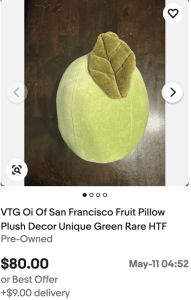
One of the biggest mistakes I see resellers make is looking at an active listing and assuming that the asking price on Ebay tells them what an item is worth.
It doesn’t.
If someone has a vintage vase listed for $119, all you know is that someone is asking $119.
They might eventually sell it for that price.
They might accept a $75 offer.
They might sell it somewhere else.
They might never sell it at all.
That’s why I always want to look at sold listings whenever possible.
When I researched one of the tea jars from this estate sale, I found active listings ranging from much lower prices to $119 and beyond. But there weren’t any sold examples that were an exact match.
That changes the research process.
Instead of simply saying, “Someone has this listed for $119, so mine must be worth $119,” I start looking for the closest possible comparisons.
Start With Google Lens or Google Image Search

One of my favorite tools when I’m researching an unusual vintage item is Google Image Search.
If I don’t know exactly what something is, I’ll take a clear photograph of it with my phone and run the image through Google.
This can be especially helpful with vintage and antique items because you may recognize the object but not know the terminology buyers use to search for it.
For example, an unusual porcelain piece might be described using terms you would never have thought to search.
Google Image Search can help you discover:
- Possible names for the item
- Manufacturers
- Patterns
- Materials
- Styles
- Similar examples
- Keywords used by other sellers
- Other marketplaces where similar pieces appear
And those keywords can become extremely useful when you create your eBay listing.
Don’t use the first result as proof
There’s an important distinction here.
Google Image Search is a research tool, not an authentication service.
If Google suggests a name or identification, I use that as a clue and then continue researching.
That’s particularly important with vintage pieces because sellers don’t always use accurate terminology in their listings.
As I like to say, just because somebody put something in their listing doesn’t mean they’re right.
But it can give you another rabbit hole to investigate.
Use eBay Sold Listings to Determine Value

Once I have an idea of what an item is, I move over to eBay and start looking at comparable items.
I want to know:
What are similar items actually selling for?
Not just:
What are people asking?
When I’m searching, I try to get as close to an apples-to-apples comparison as possible.
That means looking at:
- Size
- Manufacturer
- Pattern
- Color
- Material
- Age
- Condition
- Completeness
- Markings
- Style
This is especially important with vintage items.
Two pieces can look almost identical in a photograph but have very different values because one is a particular pattern, manufacturer, size, or variation.
What If There Are No Sold Comps?
This is one of the questions I get frequently:
“What do I price something at when I can’t find an exact sold listing?”
It happens all the time.
In fact, several of the items from this estate sale didn’t have an exact match that I could find.
When that happens, I don’t automatically decide the item is worthless.
Instead, I broaden my research.
I’ll look for items that are:
Similar in size.
Similar in style.
Made by the same manufacturer.
Made from the same material.
Similar in color or pattern.
Then I compare those examples and try to get a feel for the market.
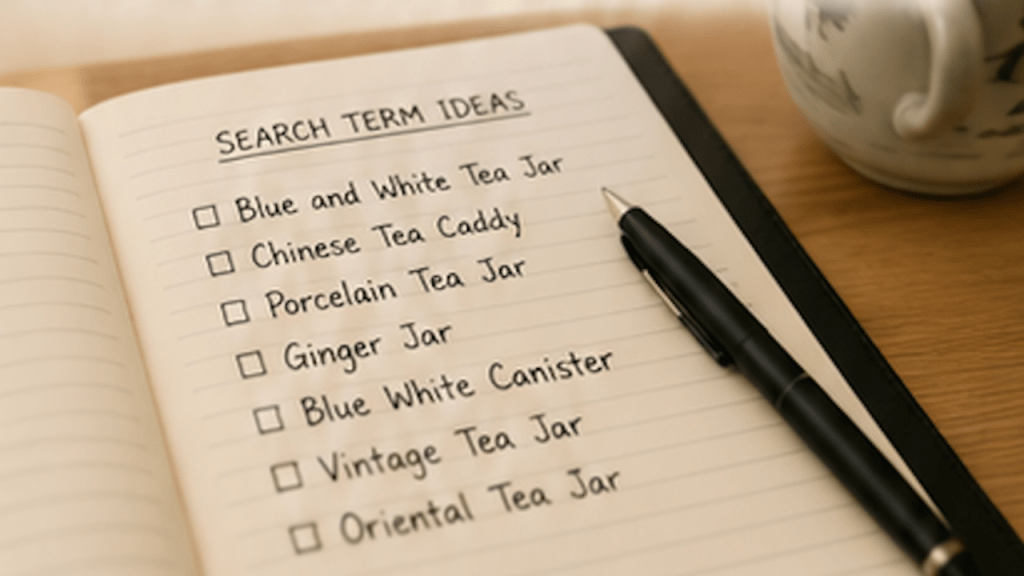
For one of my vintage tea jars, for example, I found similar pieces ranging from around $28 to $140. That’s a huge range, which tells me that simply searching for “ginger jar” isn’t enough.
I need to determine what makes the higher-priced examples different from the lower-priced ones.
Look at the Competition, Too

Sold listings tell me what has actually sold.
Active listings tell me what I’m going to be competing against.
I want to look at both.
Suppose I find an item with several sold examples around $50.
That sounds promising.
But then I discover that there are currently 75 identical items listed for $45.
Now I have another problem.
Even if the item can sell for $50, I need to consider how long it might take to sell.
That’s why I look at:
How many are currently listed?
How many have sold?
What prices are sellers asking?
How long might mine sit?
Can I make enough money to justify the work?
This is one of the most important parts of becoming a better reseller.
An item doesn’t have to be valuable to be profitable—and an expensive item isn’t automatically a good buy.
Your Photos Can Make a Difference
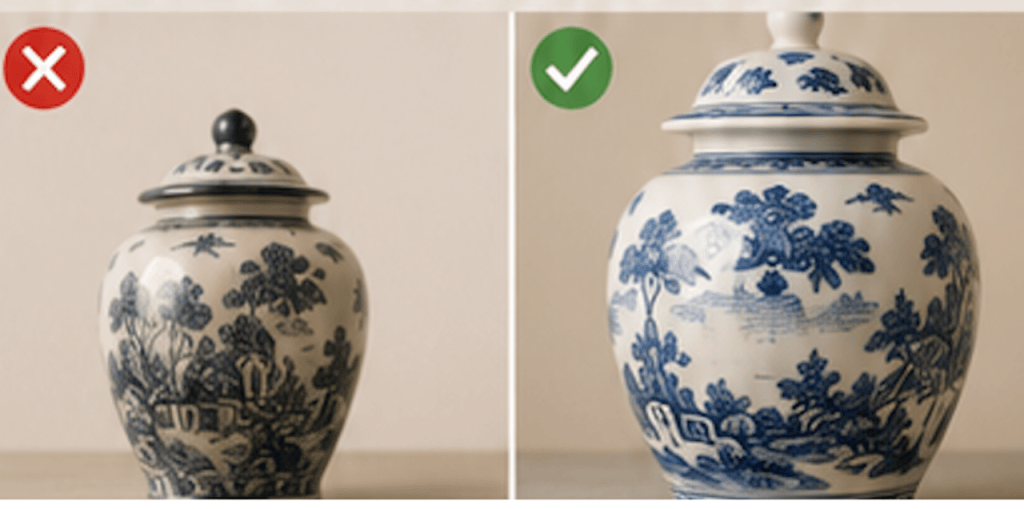
Something else I pay close attention to while researching comparable listings is how other sellers photograph their items.
This is something you can learn a lot from.
If I find an item similar to mine selling for a higher price, I want to look at that seller’s photographs.
Are they bright?
Can I clearly see the details?
Is the item filling most of the frame?
Is the background distracting?
Are there close-ups?
Can I see the maker’s mark?
Are condition issues clearly shown?
Sometimes the difference between an ordinary-looking listing and an appealing listing is simply the photography.
When I found a particularly beautiful example of a vintage vase during my research, I immediately noticed how much the photograph helped the item stand out.
That made me think about how I could photograph my own piece so that my listing stands out from the other examples sitting beside it in search results.
Always Inspect Vintage Items for Damage
Before I decide on a final price, I also need to know the condition.
Especially with vintage ceramics and glass, I’m looking for:
- Chips
- Flea bites
- Cracks
- Repairs
- Crazing
- Staining
- Wear to painted decoration
- Wear to gold trim
- Missing pieces
- Replacements
- Damage to lids or bases
And sometimes I don’t notice a flaw until I’m photographing or researching the item.
That happened with a small reverse-painted glass bell ornament I picked up.
I noticed a tiny flea bite that I had completely missed initially.
It was very small, but it still needed to be disclosed in the listing.
That’s an important lesson with vintage reselling:
The condition can change the value just as much as the item itself.
Smaller items can be especially attractive because they’re easier to store and ship.
An Example: The Reverse-Painted Owl Bell
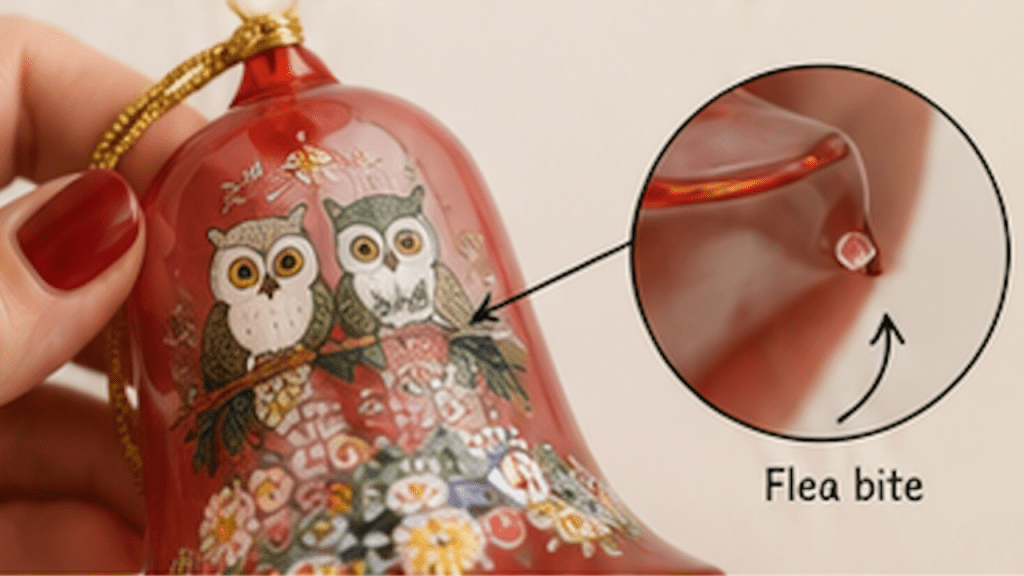
One of my favorite little finds from this estate sale was a glass bell decorated with owls.
I knew it was a reverse-painted piece, but I wasn’t completely sure about the artwork or its age.
So I photographed it and searched the image.
That led me down several different paths, including searches for:
- Reverse-painted bell
- Glass bell ornament
- Owl ornament
- Vintage glass ornament
- Hand-painted owl ornament
- 12 Days of Christmas
I also discovered artwork that appeared related to Jan Brett’s The 12 Days of Christmas, which gave me another possible avenue for research.
The problem?
There weren’t a lot of exact matches.
And that’s okay.
When there’s very little sales history, I’m more cautious about the price.
In this case, I was considering something around $19.99 with Best Offer, rather than pricing it extremely high based on one random active listing.
Sometimes the Research Is More Valuable Than the Item
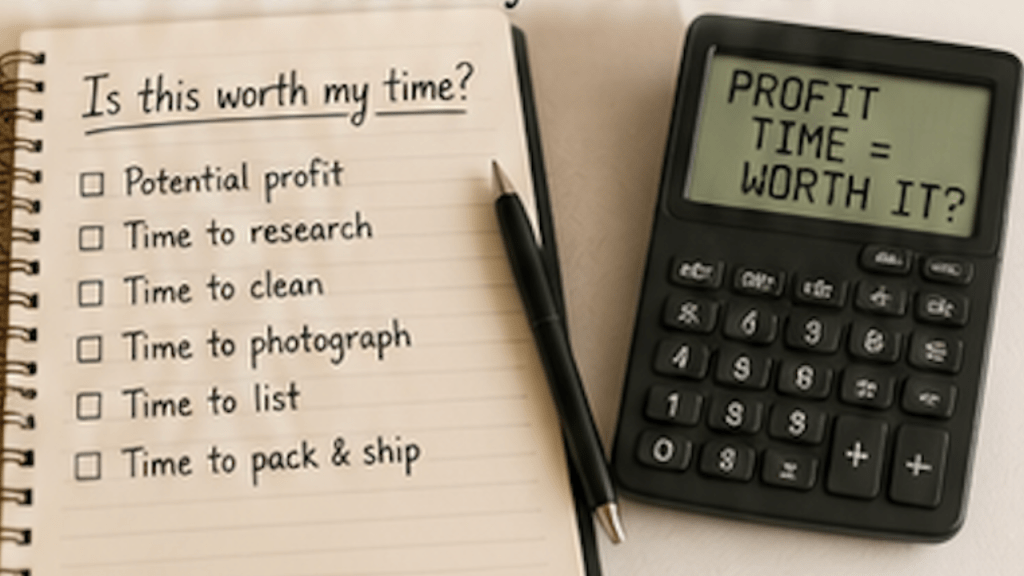
Here’s another lesson I’ve learned from reselling:
You can spend an hour researching a $20 item if you aren’t careful.
I love going down research rabbit holes.
Vintage pieces can be fascinating, and every time I research something, I usually learn something new.
But there comes a point where I have to ask:
“Is this research actually going to help me make money?”
If I’m researching a $30 item for an hour, I’ve just eaten up a significant portion of the potential profit with my time.
So I try to balance curiosity with practicality.
Sometimes I keep researching because the item might be significantly more valuable than I initially thought.
Other times, I get enough information to make a reasonable pricing decision and move on.
An Unusual Item Can Be Harder to Price
One of the more interesting pieces I found was a millefiori paperweight.
Millefiori glass is recognizable by the little floral or mosaic-like glass patterns created from glass canes.
But even within a category like millefiori, there can be huge differences between pieces.
Color, pattern, manufacturer, size and overall design can all matter.
I found comparable paperweights priced at everything from relatively modest amounts to well over $100.
That made it clear that I couldn’t simply say:
“It’s a millefiori paperweight, so it’s worth X.”
I needed to determine which examples were actually comparable to mine.
That’s the difference between identifying an item and valuing an item.
Don't Forget the Fun Finds
Not everything I buy at an estate sale is strictly about profit.
One of the things I love about treasure hunting is that sometimes I find something that simply makes me happy.
I picked up a little metal nun figurine playing an instrument, and instead of immediately thinking about resale value, I started imagining her personality.
I also had another little figurine from a previous garage sale, and naturally, I decided the two were married.
They’re staying with me.
That’s one of the realities of thrifting and estate-sale shopping.
Sometimes you buy for eBay.
Sometimes you buy for your house.
And sometimes you buy something because it makes you smile.
My Estate Sale Haul: About $15 Into About $300
Although I spent around $300 total at this estate sale, most of that money went toward jewelry and other higher-priced purchases that I’ll cover separately.
After estimating the portion allocated to the vintage hard goods and breakables in this haul, I figured I had about $15 invested in these particular items.
My estimate was that they could eventually bring in around $300 in profit once everything sells.
That doesn’t mean $300 is guaranteed.
Some items may sell quickly.
Others may sit for a while.
I may have to adjust prices.
And there are always fees, shipping supplies, time and other expenses to consider.
But that’s exactly why I enjoy this process.
The goal isn’t simply to find something old.
The goal is to find something where the potential selling price makes the investment of money and time worthwhile.
My Simple Estate Sale Research Process

If you’re new to reselling, here’s the basic process I’d recommend using when you find something you think might be valuable.
1. Identify what you have
Look for:
- Maker’s marks
- Labels
- Signatures
- Model numbers
- Country of origin
- Pattern names
- Copyright dates
- Materials
2. Take a photograph
Use Google Image Search or Google Lens to find similar examples and discover terminology you may not know.
3. Search eBay
Start with the most specific keywords you know.
Then experiment.
Remove a word.
Add the manufacturer.
Add the material.
Add the size.
Try a different description.
4. Check SOLD listings
This is one of the most important steps.
Don’t base your expected selling price solely on active listings.
5. Compare apples to apples
Pay attention to size, condition, manufacturer, pattern, color and completeness.
6. Check the current competition
How many identical or nearly identical pieces are currently listed?
7. Look at the photographs
See what successful sellers are doing visually.
8. Inspect your item carefully
Look for damage and disclose everything.
9. Decide what your time is worth
A $20 sale isn’t necessarily a good sale if it takes an hour to research, clean, photograph, list and pack.
10. Price strategically
You don’t always have to be the cheapest.
If your item is in excellent condition and your photographs are better, you may be able to price it accordingly.
The Biggest Lesson From This Estate Sale
The most important thing I took away from this haul is something I think applies to almost every reseller:
Just because something is vintage doesn’t mean it’s valuable.
And just because you can find somebody asking $100 for something doesn’t mean you’re going to get $100 for it.
The real skill is learning how to research an item, understand the market, evaluate the competition, recognize condition issues and make a pricing decision that makes sense for you and your business.
That’s where the money is.
And honestly, that’s one of the things I love most about reselling.
Every estate sale gives me an opportunity to learn something new.
Sometimes I find a great BOLO.
Sometimes I find a $20 item.
Sometimes I find something I want to keep.
And every once in a while, I find a $15 pile of treasures that might turn into $300.
That’s the fun of the hunt.