How to Tell Ivory From Bone: A Guide for Thrift Store Resellers
Finding vintage jewelry, carvings, and other unusual items at thrift stores can be exciting. But sometimes you may pick up a piece and wonder: Is this ivory, bone, or something else entirely?
Knowing how to recognize the characteristics of ivory and bone is important for collectors and resellers. Ivory can be subject to significant federal, state, and international restrictions, while bone generally does not have the same restrictions.
The important thing to remember is that no single visual clue or simple home test can always identify a piece with certainty. When an item could potentially be ivory, identification and legality are two separate questions.

Why This Matters for Your Reselling Business
Ivory traditionally refers to the hard, dense material found in the teeth or tusks of certain animals, including elephants and walruses. Some other animal teeth and tusks can also be subject to specific laws and regulations.
Bone, on the other hand, is the skeletal material of animals and is commonly found in vintage carvings, jewelry, buttons, handles, and decorative objects.
The problem for resellers is that ivory, bone, and imitation materials can sometimes look surprisingly similar.
If you incorrectly identify an item as ordinary bone when it may be a restricted material, you could end up with an item you cannot legally sell. On the other hand, assuming every cream-colored carved piece is ivory could cause you to pass up perfectly legitimate and potentially valuable bone items.
The goal isn’t to become an expert overnight. It’s to learn the characteristics that can help you decide when an item is worth researching further and when it’s better to walk away.
If you’re a thrift store or estate sale reseller, learning to recognize ivory isn’t about finding ivory to resell.
It’s about avoiding it.
I recommend that resellers do not knowingly purchase suspected ivory at thrift stores, estate sales, garage sales, auctions, or other sourcing locations with the intention of reselling it.
The problem is that you don’t always know what you’re looking at when you’re shopping.
A carved piece may be sitting in a jewelry jar labeled “bone,” “carved jewelry,” or simply “vintage necklace.” You might buy a mixed jewelry lot and discover later that one of the pieces appears to be ivory.
That’s why knowing the basic characteristics of ivory and bone is useful.
You want to be able to recognize the warning signs before you buy, or identify a questionable piece that has accidentally come into your inventory so that you don’t unknowingly list or sell it.
This is especially important because major online marketplaces have their own policies regarding ivory and animal-derived materials. Those platform rules can be stricter than what federal law might allow in certain circumstances.
For a reseller, “technically legal somewhere” does not necessarily mean “allowed on my selling platform.”
The Goal: Identify It So You Don’t Buy or Sell It
When you’re sourcing, think of this as a stop-and-check process, not an ivory-hunting technique.
If a piece looks like it could be ivory:
Stop. Don’t buy it simply because you think it might be valuable.
If you already own the item because it came in a jewelry lot:
Stop. Don’t list it until you’ve determined what it is and whether it can legally and legitimately be sold.
And if you can’t confidently identify the material:
Don’t guess.
There are plenty of other vintage jewelry pieces you can buy and sell without taking on the uncertainty.
Ivory vs. Bone: What Should You Look For?
There isn’t one simple test that can positively identify every piece of ivory.
Instead, look at several characteristics together:
- Grain or structural patterns
- Tiny pores or openings
- The overall texture
- Color and aging
- The construction of the piece
- Carving and wear
- Any available provenance or history
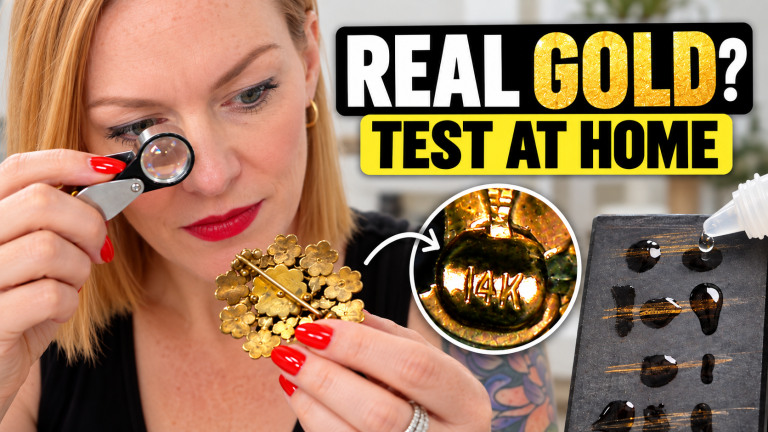
A magnifying glass or jeweler’s loupe can be extremely helpful.
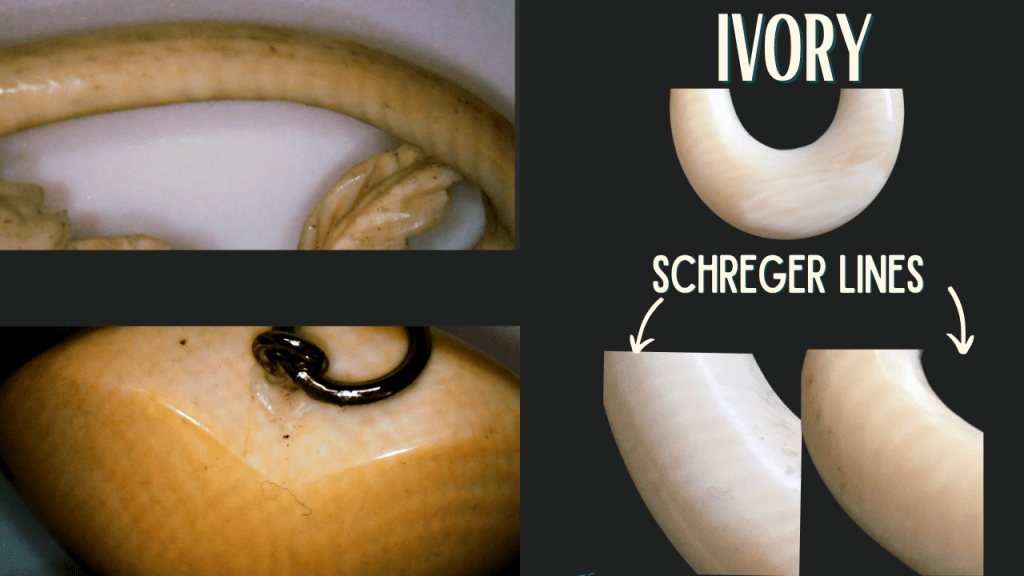
The Pattern Test
One of the most useful clues when examining certain types of ivory is a distinctive cross-hatched pattern known as Schreger lines.
In elephant ivory, these lines can appear as intersecting arcs or curved lines. Under magnification, they can form a distinctive geometric pattern.
However, don’t treat the presence or absence of a pattern as absolute proof of what a material is. The appearance can vary depending on the species, the way the material was cut, the condition of the surface, and other factors.
Bone has a different internal structure. Under magnification, you may see small pores, channels, or irregular structures associated with the bone’s vascular system.
The key point: Don’t rely on a simple “curved lines = ivory, dots = bone” rule. Use these characteristics as clues that need to be considered together.
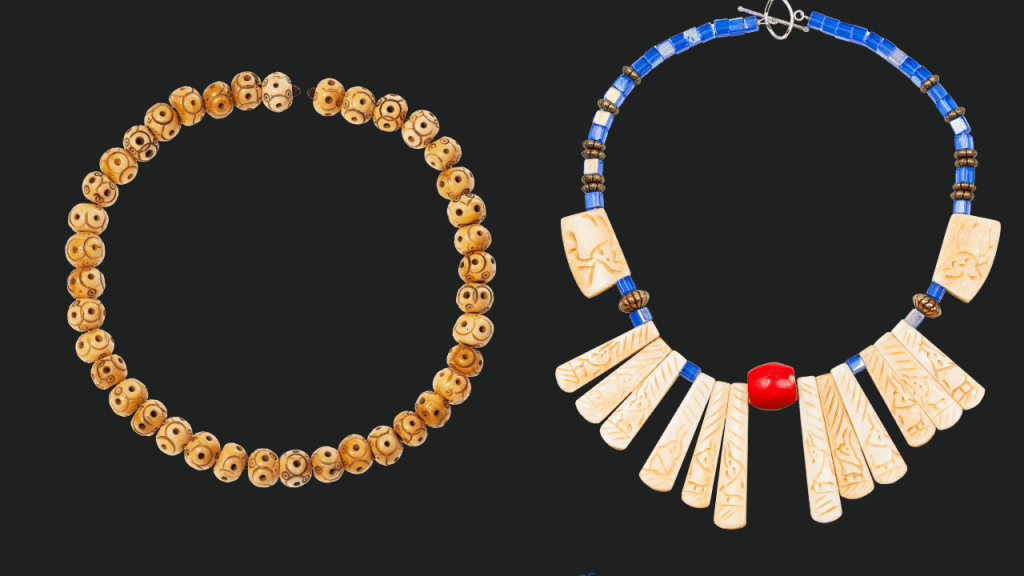
Use Magnification
A jeweler’s loupe or magnifying glass is one of the most useful tools you can carry when you’re shopping for vintage jewelry and small carved objects.
Look closely at an unfinished area, edge, underside, or another place where the material’s structure is visible.
With bone, you may see:
- Small pores or openings
- Irregular channels
- A less uniform structure
- Variations in texture
With ivory, some specimens may show:
- Fine intersecting curved lines
- A dense, relatively uniform structure
- A smooth surface
- Subtle grain-like patterns
The more examples you examine, the easier it becomes to recognize differences.
What About Weight?
You may hear that ivory is heavier than bone.
There is some truth behind this because ivory is a dense material, but weight alone is not a reliable identification test.
The size, thickness, shape, construction, and density of an individual object can all affect how heavy it feels.
A small piece of bone can feel surprisingly substantial, while a carved ivory object may be hollowed, thin, or constructed in a way that changes its weight.
Use weight as a clue—not as proof.
Color Can Offer Clues, But It Isn’t Proof
Ivory is often associated with a warm white, cream, or yellowish color. Older ivory can develop darker yellow, tan, or brown coloration over time.
Bone can also be white, cream, yellow, tan, gray, or brown depending on its age, treatment, and condition.
That’s why color alone isn’t enough.
A piece that is yellow doesn’t automatically mean it’s ivory, and a white piece isn’t automatically bone.
Vintage plastics and other imitation materials can also develop colors that resemble aged ivory.
What Does Ivory Feel Like?
Ivory is often described as smooth, dense, and somewhat warm or silky to the touch.
Bone can also be smooth, especially when it has been polished.
Some bone objects have visible pores or a slightly textured surface, particularly on unfinished areas.
Again, feel is a supporting clue rather than a definitive test.
A highly polished bone carving may feel very different from an unfinished piece of bone.
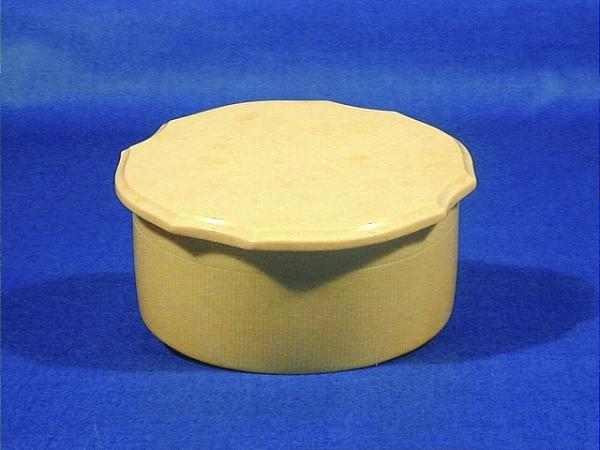
What About Plastic and Faux Ivory?
This is especially important for thrift store resellers.
Not every cream-colored carved object is an animal material.
Vintage and modern jewelry and carvings can be made from:
- Plastic
- Resin
- Acrylic
- Celluloid
- Other synthetic materials
- Faux ivory or imitation ivory
Some of these materials can look remarkably convincing.
Look closely at the piece’s construction and surface. Perfectly uniform color, obvious mold lines, seams, bubbles, or other signs of manufacture can suggest a synthetic material.
However, don’t assume that the absence of those clues proves an item is ivory or bone.
When the material could be valuable or legally restricted, professional identification is the safest option.
The Blacklight Test
If you have a UV blacklight, it can sometimes provide an additional clue, but it cannot reliably distinguish ivory from bone by itself.
Both bone and ivory can fluoresce under ultraviolet light, and the appearance can vary depending on the material, surface treatment, age, and other factors.
UV light can sometimes be useful as part of a broader examination, particularly when you’re trying to identify obvious synthetic materials.
But don’t use a blacklight result as proof that an item is ivory or bone.
Think of it as one clue among many, not a definitive identification test.
What About the Temperature Test?
You may also hear that ivory stays cool longer than bone or that bone warms up more quickly in your hand.
This isn’t a reliable enough method to identify an item.
Temperature changes are affected by the object’s size, thickness, surrounding temperature, your own body temperature, and the material itself.
It’s fine to notice how an object feels in your hand, but don’t use the temperature test to decide whether something is ivory.
Skip the Hot Needle Test
You may see the hot needle test recommended as a way to identify ivory, bone, or plastic.
I don’t recommend using it on vintage or potentially valuable items.
A heated needle can permanently damage the object, and it still won’t reliably distinguish ivory from bone.
You could end up putting a burn mark into a potentially valuable antique just to learn something that a destructive test couldn’t tell you with certainty anyway.
For thrift-store finds, non-destructive examination should come first.
If an item appears potentially valuable or could be made from a restricted material, it’s better to seek qualified identification rather than deliberately damaging it.
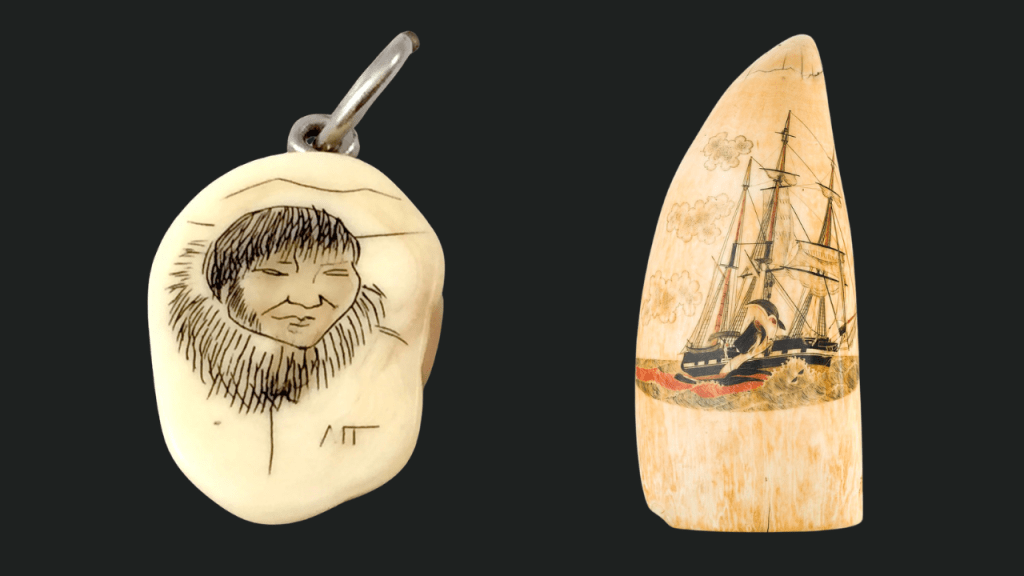
What About Scrimshaw?
Scrimshaw requires extra caution.
The term “scrimshaw” generally refers to engraved or carved artwork traditionally associated with marine-mammal materials, particularly whale teeth and bone.
The important thing for resellers is that “scrimshaw” is not simply a style name you can use without considering the material.
A piece described as scrimshaw may involve a material that is subject to wildlife laws or marketplace restrictions.
For example, eBay’s current animal-products policy prohibits products made from marine mammals and specifically prohibits ivory, bones, or other products from several ivory-producing animals, including sperm whales, narwhals, orcas and walruses.
So if you find an old carved tooth or suspected whale-tooth scrimshaw at an estate sale:
Don’t assume that its age makes it safe to resell.
Set it aside and research the species, material, applicable laws, and the policies of the platform where you normally sell.
What If You Find an Animal Tooth or Tusk?
Don’t automatically assume that every tooth or tusk is legal to sell.
Different species can have very different protections.
For example, federal wildlife regulations can apply to elephant ivory, marine mammals, and other protected species. The U.S. Fish & Wildlife Service specifically recommends determining the species and maintaining documentation showing the item’s origin and chain of ownership when dealing with elephant ivory.
As a reseller, you generally don’t have enough information at a thrift store to establish all of that.
That’s another reason my advice is simple:
If you suspect that an item is ivory or another regulated animal material, leave it behind.
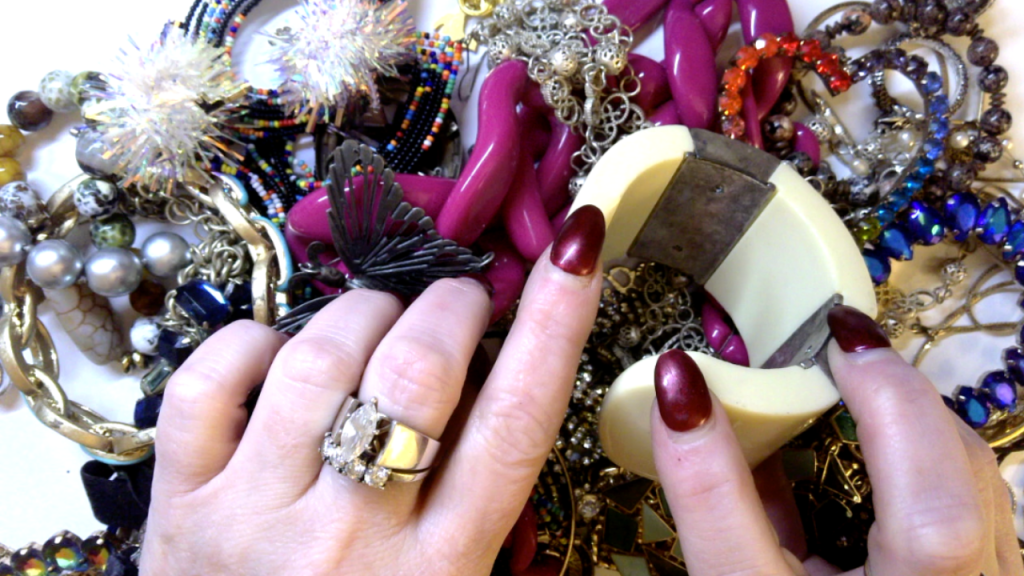
What If You Already Bought It?
This is where identification becomes particularly important.
Maybe you didn’t knowingly buy ivory.
Maybe you purchased a $20 jewelry jar and discovered a questionable carved pendant inside.
Maybe an estate-sale seller told you something was bone and you’re now seeing characteristics that make you question that identification.
Don’t panic—but don’t list it until you know what you’re dealing with.
Set it aside and:
- Examine it carefully without damaging it.
- Photograph the piece and its identifying features.
- Look for markings, provenance, and documentation.
- Compare the material with known examples.
- Consult a qualified expert if necessary.
- Check the laws that apply to the specific material.
- Check the rules of your selling platform.
The important thing is to avoid turning an accidental acquisition into an accidental prohibited sale.
What If You Find Ivory in a Jewelry Lot?
This is an important situation for resellers.
Sometimes you don’t knowingly purchase an ivory item at all.
You buy a large jewelry jar, grab bag, estate collection, or box of mixed vintage jewelry, and only discover the questionable piece when you’re sorting everything at home.
If that happens, don’t simply photograph it and put it in your next eBay listing.
Set the piece aside.
Don’t list it.
Don’t describe it as bone if you’re not certain that it is bone.
Don’t try to disguise the material by calling it “vintage carved material,” “unknown stone,” or another vague description.
Instead, investigate what you have and determine whether the item is made from a restricted material.
This is one of the reasons I recommend that jewelry resellers learn basic material identification. The more you know, the less likely you are to accidentally list something that violates marketplace rules or applicable laws.
When in Doubt, Don’t Guess
If you’re standing in a thrift store and can’t confidently determine what a questionable piece is made from, you have several choices.
1. Pass on the item
This is often the smartest choice for a reseller.
There are plenty of other jewelry and vintage finds that don’t come with the same uncertainty.
2. Research it before buying
If the store allows you to put an item on hold, take photographs and research the material, construction, markings, and similar examples.
3. Ask a qualified expert
An experienced antique appraiser, museum professional, or specialist familiar with the material may be able to help.
4. Don’t rely on the seller’s description
A thrift store tag saying “ivory” doesn’t necessarily establish what the material actually is.
Likewise, a tag saying “bone” doesn’t guarantee that the identification is correct.
Treat descriptions as information to investigate—not proof.

Important Ivory Laws for Resellers
This is the part where you need to be especially careful.
Ivory laws are complicated and can vary depending on the species, age, origin, provenance, location, and type of transaction. Federal, state, and international rules can all come into play.
Federal law places significant restrictions on the commercial trade in elephant ivory, but there are specific circumstances and exemptions involving certain antique and other ivory items.
Simply being more than 100 years old does not automatically mean an ivory item can be sold without restrictions. Documentation and other requirements may apply.
Individual states can also have stricter rules than federal law.
International sales can involve additional restrictions and permits.
Bone generally does not face the same elephant-ivory restrictions, but animal-derived materials can have their own regulations depending on the species.
Important: This article is provided for general educational purposes and is not legal advice. If you believe an item may be ivory or another regulated animal material, verify the current laws that apply to your specific situation before buying, selling, shipping, or exporting it.
Common Mistakes to Avoid
Don’t assume every cream-colored carving is ivory.
Bone, plastic, resin, celluloid, and other materials can look similar.
Don’t assume every white piece is bone.
Appearance alone isn’t enough to establish the material.
Don’t rely on a blacklight.
UV light can provide clues, but it cannot conclusively identify ivory.
Don’t use destructive tests on valuable items.
A hot needle can damage an object and still won’t give you a definitive ivory-versus-bone identification.
Don’t rely on one characteristic.
Look at the material’s structure, surface, construction, age, provenance, and other available evidence together.
Don’t confuse identification with legality.
Even if you correctly identify an object as ivory, that doesn’t automatically mean it is legal to sell.
How to Build Your Identification Skills
The more examples you examine, the better you’ll become at recognizing different materials.
Try:
- Visiting museums with labeled collections
- Studying authenticated examples
- Examining known bone pieces with a loupe
- Comparing different types of vintage plastics
- Photographing interesting material patterns
- Learning to recognize Schreger lines
- Talking with experienced antique and jewelry dealers
The goal is to develop an eye for materials rather than memorizing one “magic test.”
Marketplace Rules: What Resellers Need to Know
Updated August 2026
This is where things get especially important.
Selling-platform policies are not the same thing as wildlife laws.
A piece may fall within a legal exception under federal law and still be prohibited by the marketplace where you want to sell it.
Policies also change, so always check the platform’s current rules before listing an unusual animal-derived material.
eBay
eBay’s current Animal Products Policy prohibits a broad range of wildlife products.
Among the prohibited items are:
- Ivory
- Bones or other products from dugong
- Elephant ivory and bones
- Hippopotamus ivory and bones
- Narwhal ivory and bones
- Orca products
- Sperm whale products
- Walrus products
- Marine mammals
- Products from endangered or threatened species
- Products from species listed in CITES Appendix I
eBay also states that sellers listing permitted animal products must identify the animal species and follow applicable U.S. Fish & Wildlife regulations.
For TGT resellers, the practical takeaway is simple: Don’t assume that an old ivory or scrimshaw piece is acceptable on eBay just because you believe it is antique. Check eBay’s current policy before doing anything with it.
Etsy
Etsy’s current Prohibited Items Policy, effective August 11, 2026, specifically prohibits ivory and bones from ivory-producing animals.
Its prohibited examples include:
- Ivory
- Bones from ivory-producing animals
- Tusks
- Elk ivory
- Fossilized ivory
- Woolly mammoth ivory
Etsy does allow certain non-ivory animal bones and antlers, provided they comply with its policies and applicable laws.
That means you should not assume that something is acceptable on Etsy simply because it is old or antique.
Mercari
Mercari prohibits taxidermy, wet specimens, and trafficked materials such as ivory or shark fins.
Mercari does state that bones, claws, pelts, and teeth can be permitted when they are not from protected species.
So a bone item isn’t automatically prohibited on Mercari—but the species matters.
If you cannot establish what animal the material came from, don’t assume that it’s safe to list.
Mercari Prohibited Items Policy
Facebook Marketplace
Facebook Marketplace prohibits the sale of animals or animal products on Marketplace. Its current Marketplace guidance specifically says that animal products aren’t allowed.
That makes Facebook Marketplace a poor choice for resellers dealing with questionable animal-derived materials.
Facebook Marketplace prohibited items
Poshmark
Poshmark’s Terms state that prohibited items may not be listed or sold, including items that are illegal to sell. Sellers are also required to have the rights necessary to sell their items and describe them truthfully and accurately. Poshmark also reserves the ability to cancel transactions involving items it determines to be prohibited.
Because the current Poshmark materials I found do not give me a sufficiently specific, current ivory/scrimshaw rule to quote confidently, I would avoid attempting to sell any prohibited items.
A Very Important Point About Bone
“Bone” doesn’t automatically mean “allowed.”
This is one of the biggest mistakes I see resellers make.
A piece made from ordinary cattle bone is very different from a piece made from the bone or tooth of a protected wildlife species.
For example, eBay permits some products made from non-endangered or non-threatened animals, but requires sellers to identify the animal species and follow applicable regulations. At the same time, eBay specifically prohibits bones and other products from several protected or ivory-producing animals.
So don’t just write:
“It’s bone, so it’s fine.”
Instead ask:
What animal did this material come from?
If you don’t know, that’s another reason to stop and research before listing.
My Advice for Thrift and Estate Sale Resellers
Here’s what I recommend:
If you knowingly identify something as ivory before buying it, leave it behind.
You’re sourcing for resale, not building a museum collection.
There are thousands of vintage jewelry pieces you can buy without taking on the legal and marketplace complications associated with ivory and protected wildlife materials.
If something accidentally comes home in a mixed jewelry lot, that’s different.
Identify it. Set it aside. Don’t list it. Don’t try to disguise it. Then determine what it is and what your options are.
That simple habit can save you a lot of trouble.
When in Doubt, Don’t Buy It
If you’re standing at an estate sale holding a $5 carved pendant and thinking:
“I think this might be ivory…”
Put it down.
The potential profit isn’t worth the uncertainty.
If you’re sorting a jewelry jar at home and discover a piece that looks suspicious:
Set it aside.
If you’re preparing a listing and suddenly realize the material might be ivory, bone from a protected species, or marine-mammal material:
Stop the listing process.
You can always research an item later.
You can’t undo a sale after you’ve shipped a potentially prohibited item to a buyer.
What This Means for Your Profits
Bone shouldn’t be overlooked just because it isn’t ivory.
Well-carved or interesting bone pieces can still be desirable to collectors, especially when they have an unusual design, age, maker, subject, or history.
For many resellers, confirmed bone pieces can also be simpler to deal with because they generally don’t carry the same elephant-ivory restrictions.
Suspected ivory is different.
Even when an ivory item appears old or valuable, the legal requirements surrounding its sale can make it unsuitable for a casual reseller.
When you’re buying for resale, the safest profit is often the profit you don’t have to worry about later.
Final Tips for Success
When you encounter a questionable carved piece, slow down.
Look at the surface. Use magnification. Examine the construction. Consider the item’s history. Compare it with known examples.
Most importantly, don’t make a purchase based on a single identification trick.
If you can’t determine what the material is and the item could potentially be ivory or another regulated animal material, walking away can be the smartest decision.
There are plenty of beautiful and collectible bone pieces, along with thousands of other vintage jewelry and smalls finds, waiting for you at thrift stores and estate sales.
Frequently Asked Questions
How can you tell ivory from bone?
Look for multiple characteristics rather than relying on one test. Magnification can reveal structural patterns, pores, and other features. Certain ivory, including elephant ivory, may show Schreger lines, while bone often shows pores and vascular structures.
Do ivory and bone look the same?
They can look very similar, particularly after polishing or carving. That’s why color and texture alone aren’t enough to identify them.
Does bone glow under a blacklight?
Bone can fluoresce under UV light, but the result isn’t consistent enough to use as a definitive identification method. Ivory can also fluoresce.
Can a blacklight identify ivory?
No. A blacklight may provide an additional clue, but it cannot reliably confirm that an object is ivory.
How can you tell ivory from plastic?
Look for construction clues such as seams, mold lines, bubbles, and unnatural uniformity, while also examining the surface and internal structure. However, some imitation materials can be extremely convincing, so difficult cases may require professional identification.
Is bone jewelry worth anything?
It can be. Value depends on factors such as age, craftsmanship, design, maker, condition, rarity, and collector demand.
Can you sell antique ivory?
Sometimes, but don’t assume that an item is legal to sell simply because it is old. Federal, state, and international laws can apply, and documentation or other requirements may be necessary.
Quick Reseller Safety Checklist
Before buying a questionable carved item:
-
Does the material appear unusual or potentially animal-derived?
-
Does it show characteristics that could indicate ivory?
-
Could it be bone, plastic, resin, or another material instead?
-
Does it appear to be a tooth, tusk, or marine-mammal material?
-
Is it described as ivory, scrimshaw, whale tooth, tusk, or another protected material?
-
If you’re uncertain, leave it behind
-
If it came in a jewelry lot, set it aside
-
Don’t use a vague material description to get around marketplace rules
-
Don’t perform destructive tests on valuable pieces
-
Check the current rules of your selling platform
-
Check applicable federal and state laws when necessary
-
When in doubt, don’t list it
The Bottom Line
For resellers, learning to recognize ivory isn’t about finding a hidden jackpot.
It’s about avoiding an expensive mistake.
Learn what ivory looks like. Learn what bone looks like. Learn what imitation materials look like. And most importantly, learn to recognize when a piece deserves to be left behind or set aside for further research.
If you accidentally receive a questionable piece in a jewelry lot, don’t panic and don’t immediately list it.
Identify it first.
And remember: the fact that something may be old, antique, or valuable doesn’t automatically make it legal to sell—and the fact that something might be legal under a particular law doesn’t mean your selling platform will allow it.
When you’re sourcing for resale, the safest strategy is simple:
If you knowingly identify ivory at the thrift store or estate sale, don’t buy it. If you accidentally acquire it, don’t sell it until you’ve determined exactly what it is and what rules apply.